

- Flooring
Is LVP or Hardwood Better for Long Beach Homes?
July 9, 2026
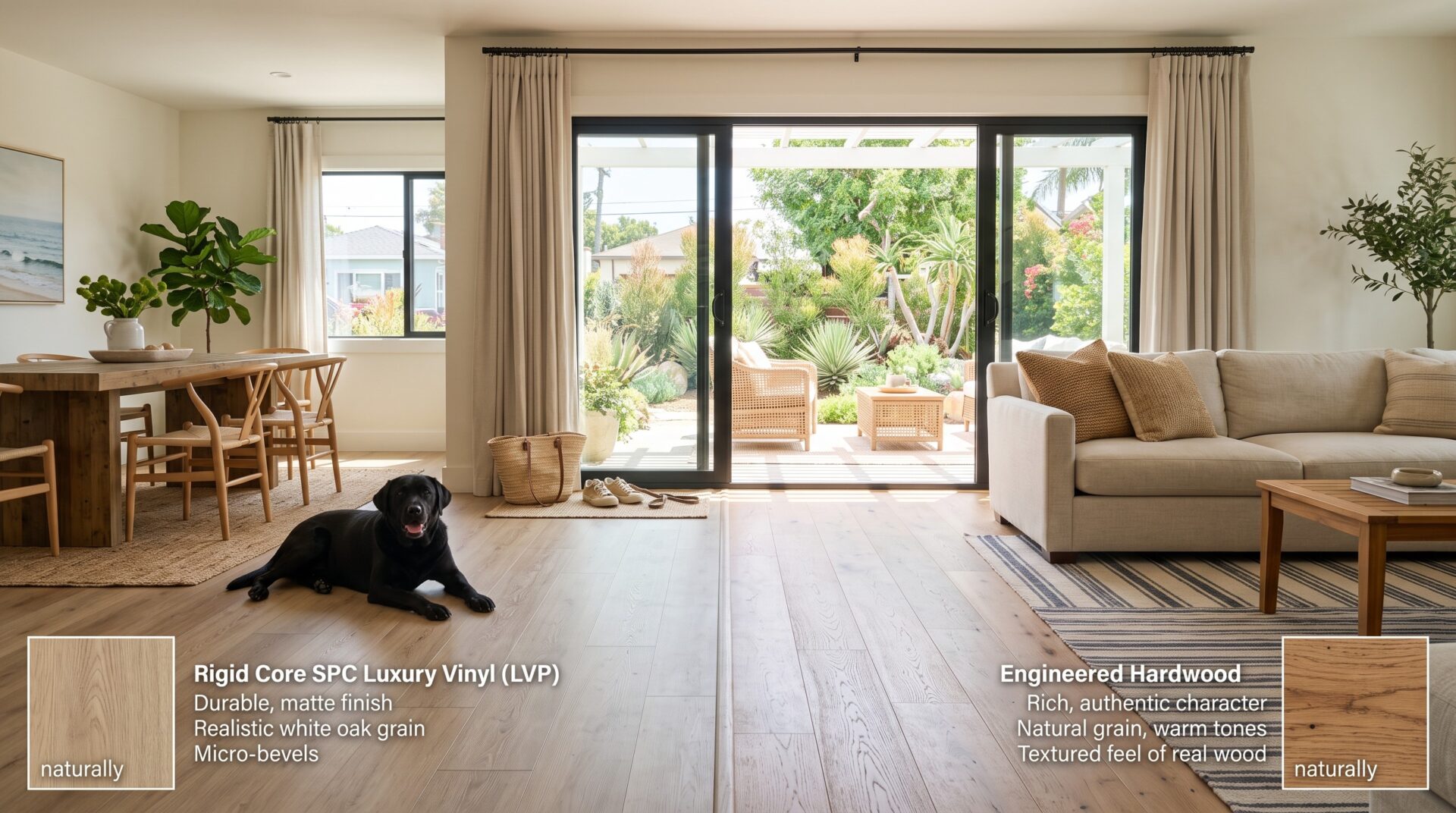
If you have spent more than twenty minutes in a flooring showroom, someone has probably told you that hardwood adds resale value and LVP is the practical choice — and then left you to figure out which one actually belongs in your Long Beach home. The honest answer is that both statements are true, and neither one is the complete picture.
The real question is which option performs better on a concrete slab under a June marine layer in a neighborhood where your golden retriever tracks sand from El Dorado Regional Park across your floors every afternoon. At Family Floors on E Spring St, we have installed both products in homes across Long Beach — from 1950s ranch houses in El Dorado Park Estates to newer builds in Bixby Village — and the decision almost always comes down to the same three factors: your foundation, your household, and the specific coastal conditions of the 90808 and surrounding ZIP codes.
We will give you the honest breakdown here. And if you want to see both side-by-side in your own space before deciding, our shop-at-home service brings full samples to your door. Call (562) 506-0505 to schedule.
Key Takeaways
- Solid hardwood cannot be nailed to a concrete slab — the dominant foundation type across Long Beach — making it an unrealistic choice for most homes without major subfloor work.
- Long Beach’s marine layer delivers humidity swings of 20-30 percentage points between morning and afternoon during summer months, the exact cycle that causes solid hardwood to cup and gap over time.
- Engineered hardwood is a genuine wood option that handles Long Beach’s slab foundations and coastal humidity far better than solid hardwood, but still requires careful species selection.
- Rigid core SPC LVP is 100 percent waterproof, handles the humidity swings and slab foundations with no modification, and holds up to sand, pets, and active family life better than any wood product.
- Family Floors carries both engineered hardwood and LVP at our Long Beach showroom, and our shop-at-home service lets you see both in your actual lighting before you decide.
- No pricing figures appear in this article per dealer policy — contact our Long Beach showroom for a free estimate tailored to your home.
Why Long Beach’s Climate Makes This a Different Conversation
The framing you see in most flooring content — LVP is better for wet areas, hardwood is better for dry areas — is too simple for Long Beach. The real challenge here is the marine layer.
From June through August, the marine layer rolls in off the Pacific and sits over South Bay and Long Beach through mid-morning, pushing relative humidity to around 80 percent by early morning. By early afternoon it burns off and humidity drops to 45-60 percent. According to NOAA climate data for the Long Beach area, that 20-30 point swing happens consistently throughout summer. It is brutal for solid hardwood. Wood fibers absorb and release moisture as humidity changes, which causes planks to expand in the morning and contract in the afternoon. Over time, that movement creates cupping, gapping between boards, and eventually cracked finishes.
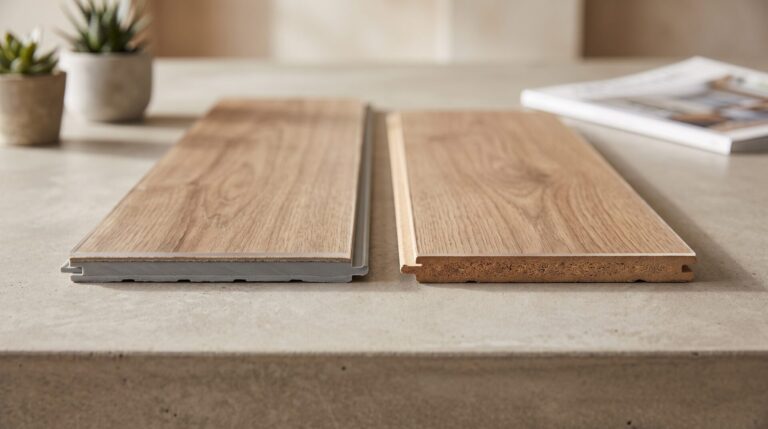
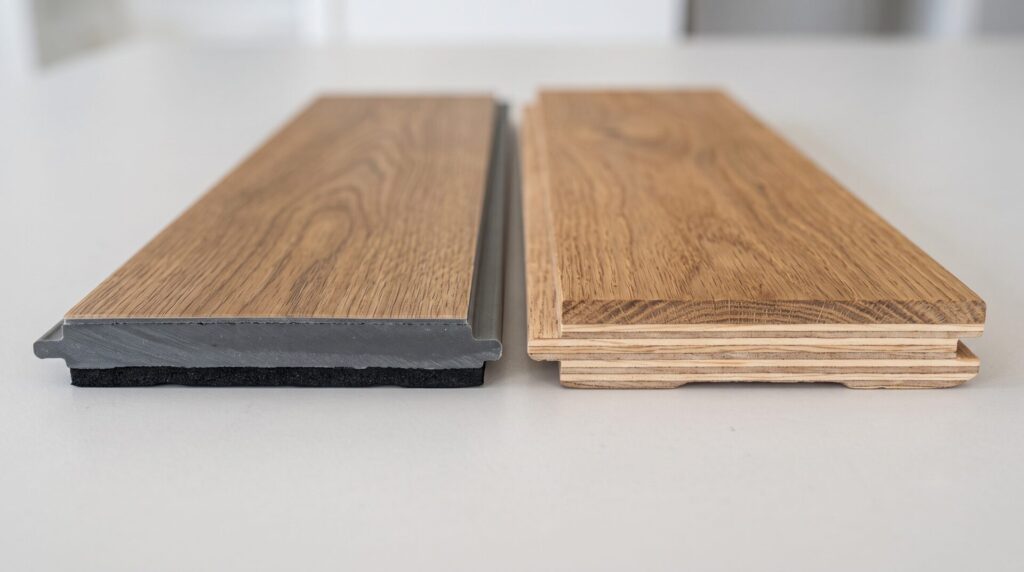
Engineered hardwood is far more dimensionally stable because the cross-ply construction limits seasonal movement. Even so, Long Beach summers test its moisture tolerance over the long term. Rigid core SPC LVP does not absorb moisture at all. For a Long Beach home in the marine layer zone, that is a meaningful real-world advantage — not a marketing claim.
Is LVP or Hardwood Better for Long Beach Homes with Slab Foundations?
Here is where the decision gets practical fast: most homes in Long Beach, including the majority of postwar ranch-style neighborhoods like El Dorado Park Estates and Lakewood Village, sit on concrete slab foundations.
Solid hardwood is not an option on a slab. Traditional nail-down installation requires a wood subfloor or sleepers, which adds significant labor and height that most homes cannot absorb. Glue-down solid hardwood on slabs is technically possible but carries long-term moisture risk — concrete slabs emit vapor even in Southern California’s relatively dry climate, and without proper moisture mitigation, adhesion and cupping problems develop over time. We see that work come back through our showroom regularly.
Engineered hardwood can be floated or glued directly to a slab, which makes it the right call for Long Beach homeowners who want real wood and are willing to invest in the right species. Oak and hickory in engineered construction perform well here, particularly in wider planks with matte or satin finishes. The National Wood Flooring Association (nwfa.org) confirms that engineered hardwood performs significantly better than solid hardwood in environments with high humidity variability — which describes Long Beach’s coastal conditions precisely. Family Floors carries Shaw and Anderson Tuftex engineered hardwood in constructions vetted specifically for this climate zone.
Rigid core SPC LVP floats over the slab with no adhesive required — though a vapor barrier is sometimes recommended on slabs with elevated moisture readings. It handles any standard slab moisture, and installs quickly. COREtec and Shaw Floorte are the two lines we recommend most often for Long Beach homes. Both use rigid SPC cores that stay dimensionally stable even with minor slab moisture variation.
“We get Long Beach homeowners in our showroom all the time who have been told hardwood is the right choice but nobody has asked them what their foundation looks like,” says Jay Glatman, owner of Family Floors. “On a slab with our coastal humidity, engineered hardwood or LVP are almost always the smarter starting point — solid hardwood is a conversation for homes with original wood subfloors.”
Add an in-text link here to the vinyl flooring page for more details on LVP options.
Where Hardwood Still Wins in Long Beach
LVP has real advantages in the conditions above. Hardwood is not the wrong answer in every Long Beach home, though. Here is where it still makes sense.
If your home has an original wood subfloor — which some older Bixby Knolls and Wrigley district homes do — solid hardwood is a legitimate option and may connect beautifully with the original character of the house. For rooms that are consistently climate-controlled and away from direct moisture sources, like a formal dining room or master bedroom with modern HVAC, engineered hardwood performs well with fewer caveats than living areas nearest to exterior doors.
Genuine wood also carries a resale signal for certain buyer segments. Long Beach’s real estate market includes buyers who will pay for real hardwood and know the difference, particularly in higher price-point neighborhoods like Park Estates and Naples Island. For those clients, the investment in correctly specified engineered hardwood can return well — though we always recommend checking with a local real estate agent before making the hardwood investment on resale grounds.
What About Pets and Active Family Life?
One factor that comes up in almost every consultation we run in Long Beach: dogs and kids.
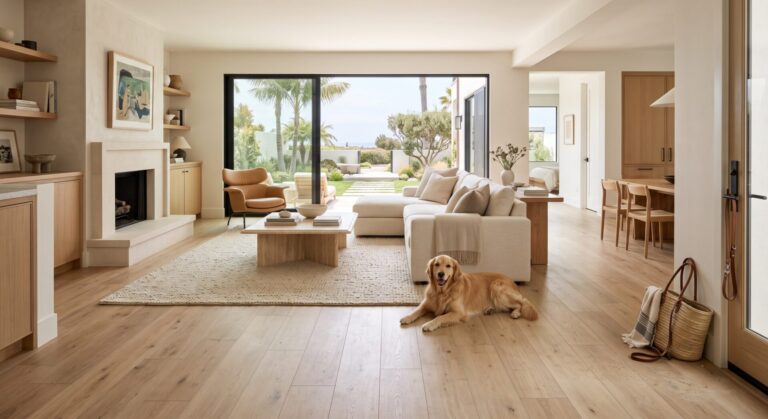
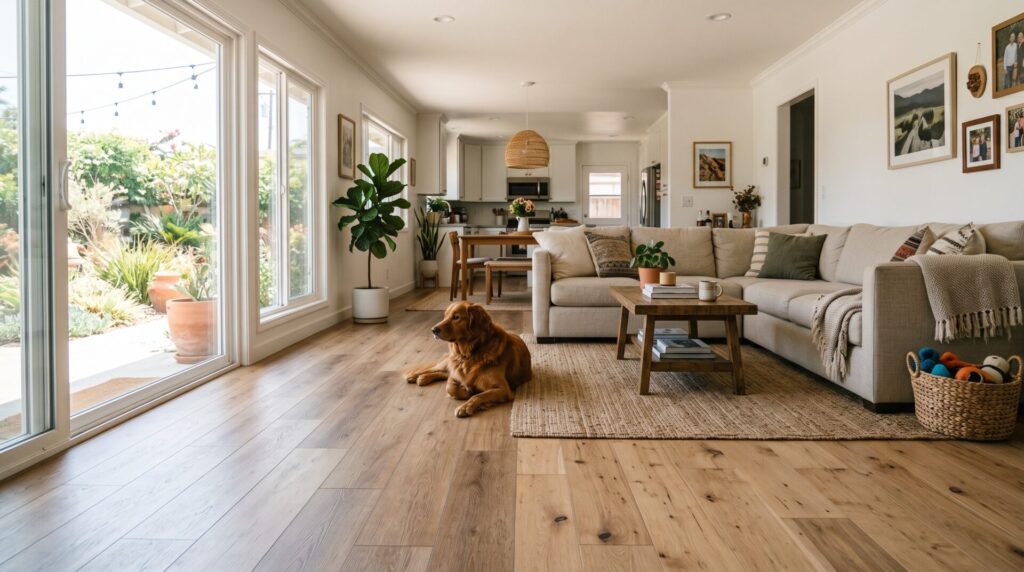
LVP’s wear layer is its biggest practical advantage for active households. A 12-mil wear layer — the standard we recommend for homes with pets — resists scratches from dog nails, stands up to the grit and sand that comes in from El Dorado Park trail use, and cleans with a damp mop. Spills, pet accidents, and the occasional water bowl overflow are non-events.
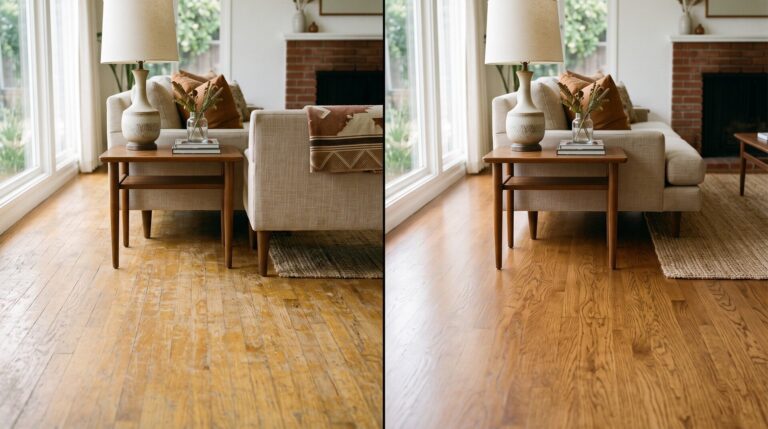
Hardwood scratches under dog nails. Even mid-range Janka species like oak can show wear from active dogs over time — hardwood simply was not designed with dog nails in mind the way LVP wear layers are. Engineered hardwood can be refinished once, or in some cases twice, depending on the veneer thickness of the specific product, but deep pet-related scratches often go through the veneer before a refinishing cycle comes due. For households with large or active dogs in Long Beach, LVP holds up better in real-world family life. Full stop.
“Family Floors is the only place I’ll trust for my future flooring projects. They’re completely transparent with process and pricing, and the quality of work is excellent. I’ve hired them for two projects at my home so far, and I was left with zero surprises or issues each time.” — Garrett D., Long Beach
How to Make the Right Choice for Your Long Beach Home
Before committing to either product, work through these questions honestly:
- Do you have a slab or wood subfloor? If it is a slab, start the conversation with engineered hardwood or LVP. Solid hardwood on a slab is a short-term decision with long-term consequences.
- What is your household like? Dogs, young kids, and beach-adjacent living push toward LVP. A climate-controlled home with minimal traffic near exterior doors opens the door to engineered hardwood.
- How long are you staying? If you are selling within five years, talk to a Long Beach real estate agent before banking on the hardwood resale premium. The premium is real in some neighborhoods and minimal in others.
- Are you willing to maintain the floor? Engineered hardwood has more stringent cleaning requirements and is more vulnerable to the humidity swings Long Beach delivers every June through August.
“If you have had 15 years of carpet and you finally want to see your floors, come in and we will show you what your options really are in a Long Beach home,” says Jay Glatman of Family Floors. “The conversation almost always gets more specific — and more interesting — once we know your foundation type and your lifestyle.”
“From the first meeting with our sales rep Jon Price, we knew we were in good hands. His no-pressure approach focused on educating us rather than trying to sell us. The installation team arrived right on schedule and within eight hours our whole house was transformed and spotless.” — Linda K., Long Beach
Frequently Asked Questions
Can solid hardwood flooring be installed on a concrete slab in Long Beach?
Solid hardwood is not recommended for direct installation on concrete slabs. Traditional nail-down installation requires a wood subfloor, and glue-down solid hardwood on slabs carries significant moisture risk in Long Beach’s coastal humidity environment without proper moisture mitigation. Engineered hardwood and LVP are both better-suited options for slab foundations.
Does the marine layer in Long Beach damage hardwood floors?
The marine layer itself does not damage floors directly, but the daily humidity swing it creates — from around 80 percent in the morning to 45-60 percent by afternoon — causes solid hardwood to expand and contract repeatedly. Over time, this movement leads to cupping, gapping, and finish cracking. Engineered hardwood handles this cycle better; rigid core LVP is unaffected.
Is LVP a good choice for Long Beach homes with dogs?
Yes. LVP’s wear layer resists the scratches that dog nails create, and waterproof LVP handles pet accidents without damage. For households with large or active dogs in Long Beach, LVP is generally the more durable choice over hardwood.
What hardwood species holds up best in the Long Beach climate?
For engineered hardwood in a Long Beach home, hickory and white oak in engineered construction are among the more stable options. Wider planks with matte finishes show seasonal movement less visibly than narrow planks with high-gloss finishes. Ask our Long Beach team about the Shaw and Anderson Tuftex engineered collections we carry.
Does LVP add resale value like hardwood does?
High-quality LVP adds real value, though some buyers and appraisers still view genuine hardwood as the premium option. In Long Beach’s market, the right answer depends on your neighborhood and your buyer pool. Consult a local real estate professional and our Long Beach team about which products have performed well in your specific area.
Can Family Floors bring samples to my Long Beach home?
Yes. Our shop-at-home service brings full-size samples of both LVP and engineered hardwood to your door so you can see them in your actual lighting and against your existing trim before making a decision. Call our Long Beach showroom at (562) 506-0505 or visit us at 6447 E Spring St to get started.
- Hardwood
- Vinyl
You Might Also Like
-

- Flooring
August 26, 2026
LVP vs. Laminate Flooring in Orange County: Which One Actually Lasts?
-
- Flooring
August 12, 2026
Can Your Hardwood Floors Be Refinished? A Long Beach Homeowner’s Guide
-

- Flooring
July 20, 2026
Best Waterproof Flooring for Huntington Beach Homes with Pets