

- Flooring
Custom Stair Runners in Long Beach: What to Expect and How to Choose
September 15, 2026
There is a specific moment most Long Beach homeowners experience after upgrading their first floor to hardwood or LVP: they stand at the bottom of the stairs, look up, and realize the worn carpet or bare wood steps are now the most dated thing in the house. The floors look great. The stairs do not.
A custom stair runner is usually the answer — and it does more than fix the visual problem. It adds grip on stairs that became slippery after the carpet was removed, cuts the noise of foot traffic echoing through a two-story home, and gives you a design element the rest of the house cannot provide: a textile surface with pattern, texture, and color running through a high-visibility architectural feature. At Family Floors on E Spring St, we fabricate and install custom stair runners throughout Long Beach. Here is what the process looks like and how to choose the right runner for your home.
Key Takeaways
- A custom stair runner is made to the exact dimensions of your stairs — not cut from a standard-width rug — which matters on older Long Beach homes where stair dimensions often do not match modern standard widths.
- The three most important decisions are fiber type (nylon, wool, or natural fiber), pile height (low-pile for longevity and cleanability), and color or pattern relative to your main floor.
- Stair runners add meaningful slip resistance on hardwood or LVP stairs — a safety upgrade that matters for homes with children, seniors, or pets.
- Family Floors measures, fabricates, and installs custom runners in Long Beach homes including Belmont Shore craftsmans, Naples two-stories, and the split-levels common in Los Altos and College Estates.
- Call our Long Beach showroom at (562) 506-0505 for a free stair runner consultation — we bring samples to your home through our shop-at-home service.
Why Long Beach Homes Need Custom Rather Than Off-the-Shelf Runners
The practical reason for going custom in Long Beach comes down to architecture. The two-story craftsman bungalows in Belmont Shore, the Spanish-revival homes in Naples Island, and the postwar split-levels in Los Altos and College Estates were built across different construction eras, and their stairs reflect that variety. Tread widths that do not match modern standard runner widths, L-shaped or curved staircases, landings that need to be covered alongside the stairs, and riser heights that vary by a quarter-inch across the flight — these are everyday realities in Long Beach’s housing stock.
A custom runner is cut from broadloom and bound specifically to your stairs. The binding — the finished edge that prevents fraying — is made to match or complement the runner color. It is measured after the stairs are assessed, fabricated to the actual dimensions, and installed to fit as if it was made for the house. Because it was.
Off-the-shelf runners work on simple straight staircases with standard dimensions. For Long Beach’s older homes, custom is almost always the better path. See our custom stair runner service for more details on what we offer.
What Fiber Type Is Right for Your Stairs?
The fiber determines how the runner performs over years of use, and the right choice depends on your household.
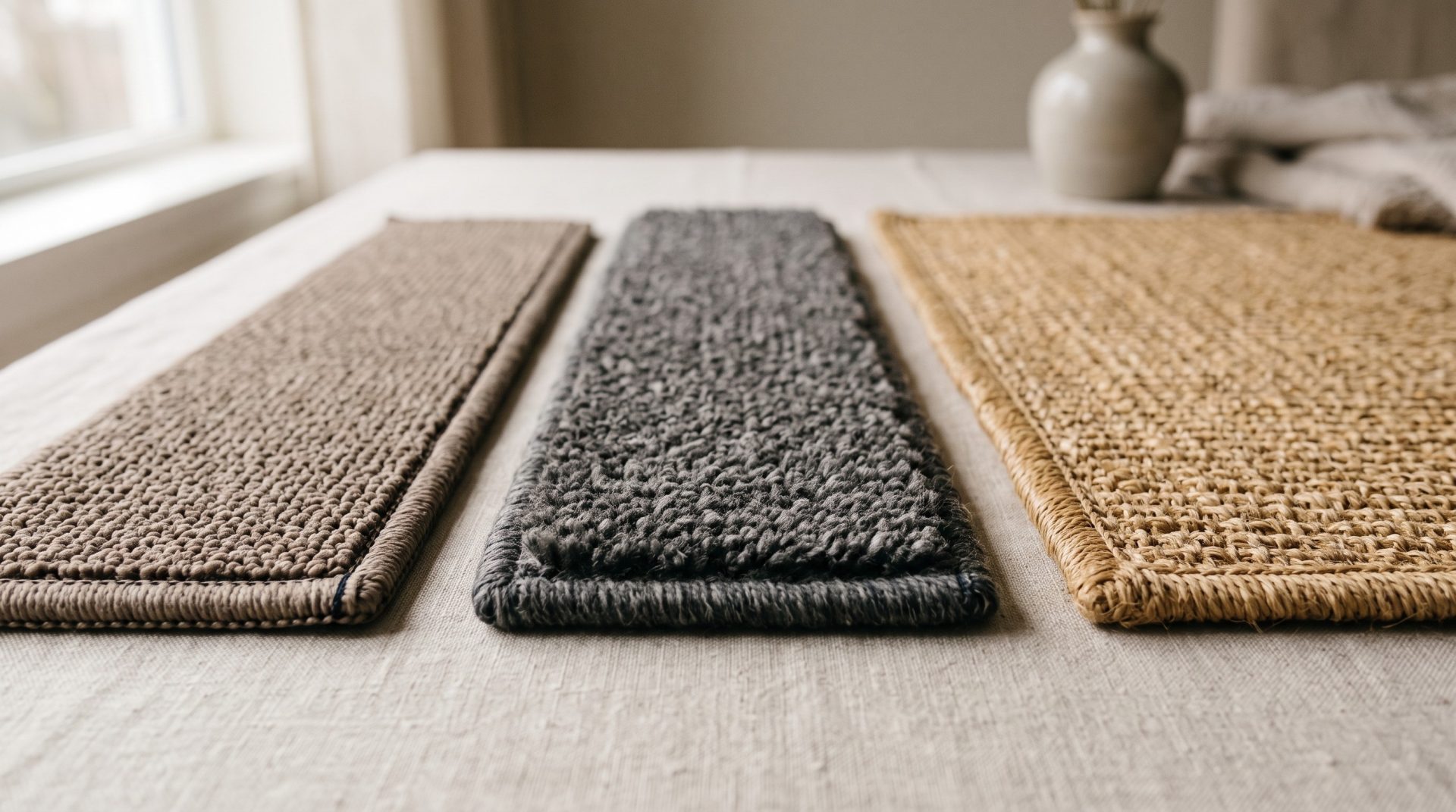
Nylon. Nylon is the workhorse of stair runners — the most common choice for Long Beach homes with kids, dogs, or heavy daily foot traffic. Anso nylon and SmartStrand (a Mohawk fiber) resist crushing and matting from stair traffic, clean well with standard methods, and hold color reliably over years of use. Solution-dyed nylon is colorfast through the fiber itself, not just the surface, which matters on stairs with consistent UV exposure from a front entryway or skylight. For households that want a runner that looks good five years from now with minimal maintenance, nylon is the reliable choice.
Wool. Wool is the premium option — softer underfoot, and with a depth of texture and color that synthetic fibers do not replicate. Wool’s natural lanolin provides some initial soil resistance, though it requires more careful maintenance than nylon on high-traffic stairs. No bleach, no alkaline cleaners, and slower to dry after wet cleaning. In a Naples Island or Belmont Shore home where the staircase is an architectural feature and aesthetics lead, wool runners are worth the conversation. For households with moderate stair traffic and a design-forward priority, wool delivers something distinctive.
Natural fibers (jute, sisal, seagrass). Natural fibers are an aesthetic choice for most Long Beach stairs, not a performance choice. They look beautiful — organic texture, warm tone — but they absorb moisture and stain permanently with most liquids. In Long Beach’s coastal climate, where beach sand and wet paws from a dog walk are daily realities, natural fiber runners on main staircases are difficult to maintain. We carry them, and we are honest with customers: these work best in lower-traffic decorative contexts, not the main staircase of an active family home.
“The fiber question is where the conversation gets personal,” says Jay Glatman, owner of Family Floors. “We have customers come in with a specific look in mind and the fiber that creates that look is not always the one that will hold up in their house. Our job is to find the option that does both.”
How to Choose Color and Pattern for Your Stair Runner
This is where most homeowners spend the most time — and where the shop-at-home service earns its value. Colors that look clear in a showroom read completely differently in your home’s actual lighting, next to your floor, trim, and walls.
A few principles that hold up across Long Beach home styles:
- Neutral tones that coordinate without competing. The runner does not need to match the floor exactly — it needs to work with it. In a home with light oak LVP floors and white trim, a warm taupe or medium gray runner reads as intentional. Cream and ivory runners photograph beautifully but show footprints on high-traffic stairs.
- Patterns that forgive traffic. Geometric patterns, herringbone weaves, and subtle multi-tone blends hide the shadow of footprints and gradual compression from daily use far better than solid single colors. A heathered or blended construction is worth considering for households with kids or dogs.
- Low pile for stair performance. Low-pile runners (under half an inch) are easier to vacuum, show less tracking from foot traffic, and work better for pattern clarity. Higher-pile runners are softer underfoot but show compression lines and pet hair more readily. For stairs specifically, low-pile constructions wear more evenly and stay cleaner longer.
Our shop-at-home service brings runner options to your Long Beach home so you can compare colors and textures in your actual staircase lighting before committing. Call (562) 506-0505 to schedule.
“We recently re-carpeted our entire two-story home after 15 years, and from start to finish, the experience with Family Floors was exceptional…Within eight hours, our whole house was transformed and spotless.” — Linda K., Long Beach
What Does the Installation Process Look Like?
Most Long Beach homeowners who have not done a stair runner before assume it is complicated. It is straightforward — but the installation details matter.
- Measurement. A Family Floors team member comes to your home and measures each tread, riser, and landing accurately. Stair dimensions vary within a single flight, and a runner that is an inch short or sits at the wrong reveal looks wrong immediately.
- Fabrication. The runner is cut from the broadloom you select and bound on both edges to the finished width your stairs require. Binding color is chosen to complement the runner. This typically takes one to two weeks from order confirmation.
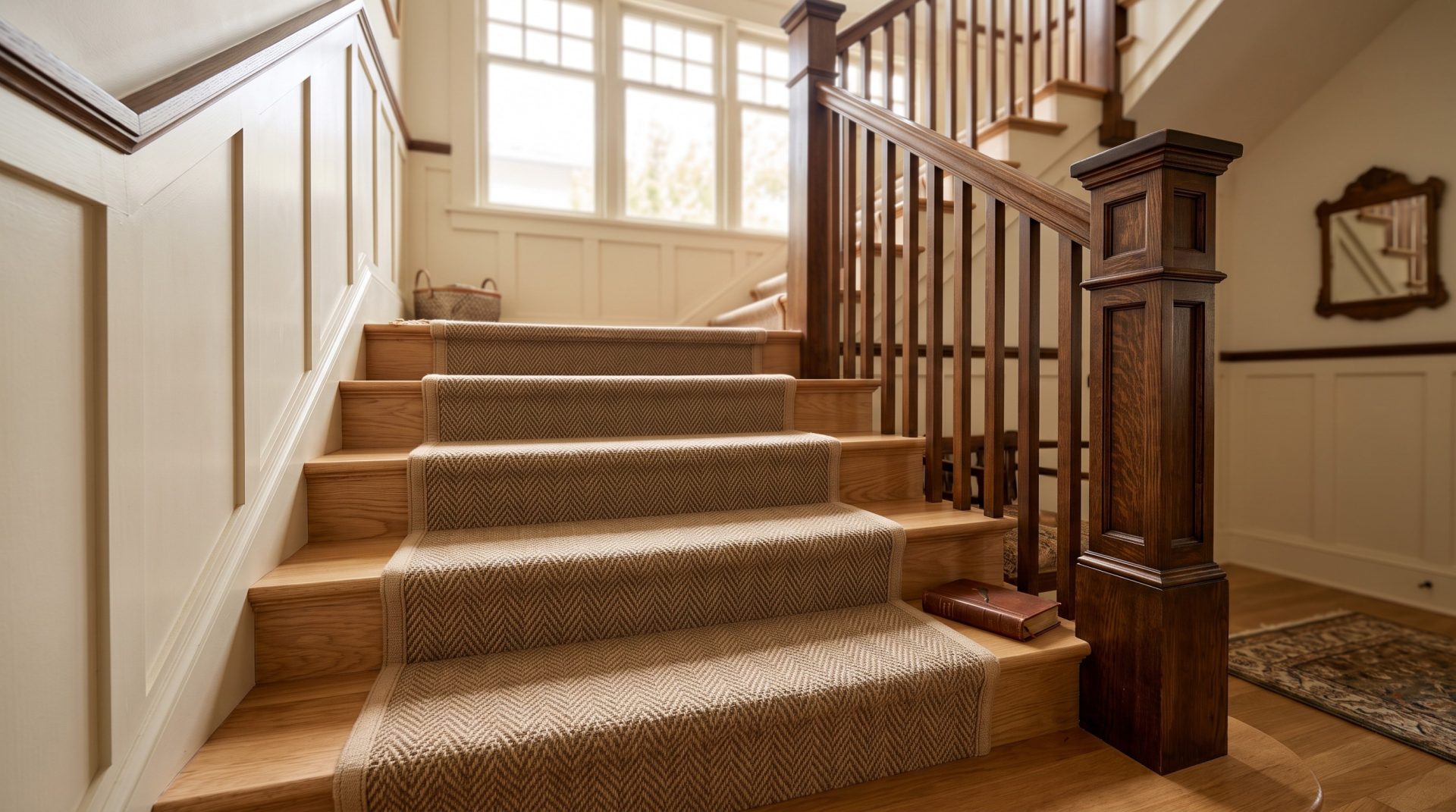
- Installation. The runner is installed using tack strips placed at the junction of each tread and riser — the standard method for wall-to-wall stair installation — with a quality pad stapled to each tread beneath. The pad gives the runner cushion, extends its life, and adds sound absorption. A runner without adequate padding compresses faster and transmits more noise.
One detail worth knowing: open-riser stairs — where there is no vertical board between treads — require a different technique than closed-riser stairs. Long Beach’s craftsman homes sometimes have open-tread stair designs, and we assess the construction before fabricating the runner. The same runner can be installed on both types, but the approach differs.
“The Family Floors staff were the ultimate professionals. They moved the furniture in a most creative way to open up the floor. The carpet was laid perfectly and looks spectacular. We are very happy with the results.” — Judy R., Long Beach
How Do Stair Runners Affect Slip Safety?
Bare hardwood or LVP stairs are among the most slip-prone surfaces in a home. The combination of a smooth hard surface and a downward angle concentrates the risk. Adding a runner — particularly one with a quality pad that prevents the runner itself from shifting — significantly reduces slip risk. The textile surface creates friction that bare wood or vinyl cannot.
For homes with young children who run up and down stairs, seniors with balance concerns, or dogs that scramble on hard stairs and stress their joints over time — this is a safety consideration, not just a design one.
The runner should cover enough of each tread that foot placement consistently lands on textile rather than the bare stair edge. We measure with this in mind and typically recommend a runner width that leaves two to three inches of exposed stair edge on each side — enough to show the underlying material while keeping the full walking surface covered.
“We talk about slip safety on every stair runner consultation,” says Jay Glatman of Family Floors. “In a home where someone has already slipped on bare wood stairs, it stops being about aesthetics pretty fast. The runner and the pad together make a meaningful difference.”
What Does a Custom Stair Runner Installation Cost in Long Beach?
The full answer depends on your stair count, runner width, fiber and construction choice, and whether your stairs include a landing. We give specific estimates after the in-home measurement visit — not from photos or square-footage guesses over the phone. Call our Long Beach showroom at (562) 506-0505 to schedule a free in-home measurement and consultation. We come to you, assess the stairs, show you options from our sample library, and give you a clear estimate before any commitment is made.
Frequently Asked Questions
How are custom stair runners different from buying a runner rug?
A custom stair runner is cut from broadloom carpet to the exact width your stairs require and bound on both edges with a finished seam. A rug runner is a pre-finished rectangle placed over stairs. Custom runners fit the specific dimensions of your stairs — important in Long Beach’s older homes where stair widths rarely match standard rug widths — and are installed with padding and tack strips for a secure, flush finish that does not shift.
What is the best carpet fiber for stair runners in Long Beach homes?
For most Long Beach households with daily traffic, kids, or pets, solution-dyed nylon is the most practical choice — it resists crushing, cleans well, and holds color through sun exposure. Wool is the premium choice for homes where aesthetics lead and stair traffic is moderate. Natural fibers (jute, sisal) are best suited for lower-traffic decorative situations rather than main staircases.
How long does a custom stair runner take to install?
Fabrication typically takes one to two weeks from order confirmation. Installation on a standard straight staircase in a Long Beach home usually takes one day or less. Curved or L-shaped stairs, or installations that include a landing, may take slightly longer.
Can a stair runner be installed over existing carpet on the stairs?
No. Stair runners are installed over bare stairs with a fresh pad — installing over existing carpet creates an unstable surface. Old carpet should be removed before a runner installation begins.
Will a stair runner make the stairs quieter?
Yes. A properly installed runner with a quality pad beneath it significantly reduces foot traffic noise on stairs. This is particularly noticeable in two-story Long Beach homes where stair noise travels through the main living area — the pad absorbs impact and the carpet fiber dampens the sound of each step.
Does Family Floors install stair runners throughout Long Beach?
Yes. We serve all Long Beach neighborhoods including Belmont Shore, Naples Island, Los Altos, College Estates, Bixby Knolls, Wrigley, and surrounding communities. Call (562) 506-0505 or visit our showroom at 6447 E Spring St to schedule a free in-home consultation.
- Carpet
- Custom Stair Runners
- Installation
You Might Also Like
-

- Flooring
August 26, 2026
LVP vs. Laminate Flooring in Orange County: Which One Actually Lasts?
-
- Flooring
August 12, 2026
Can Your Hardwood Floors Be Refinished? A Long Beach Homeowner’s Guide
-

- Flooring
July 20, 2026
Best Waterproof Flooring for Huntington Beach Homes with Pets